Ten Minutes to Andromeda
Back to Astrophotography!
Field Note: a new processing tool, an hour from the front door, and what the airplanes did to my sky
After two months buried in DaVinci Resolve finishing a family video project, I finally got back under the sky on October 11. The target was an easy choice: M31, the Andromeda Galaxy, riding high in the east.
The capture
The Seestar S30 Pro did the work: 181 subframes at 20 seconds each, a little over an hour of integration, from the usual spot about 70 feet from my front door. For once I didn't stand guard over it. The S30 Pro's WiFi reached far enough that I could watch from inside the house, with only a couple of reconnects that sent me back outside. On a cool October night in Bortle 9, I'll take that.
The AIQ logged a composite score of 35, with transparency and seeing both at 3. Sky brightness hovered around 17.46 mag/arcsec². Before I built the AIQ, my go-to test for an imaging night was simple: can I see the North Star? Last night I couldn't. Under the old rule I might have stayed inside. Instead, I let the scope run, and the result surprised me.
The airplanes
Then something I didn't expect. Park Ridge sits right under the O'Hare approach, and every time a plane passed overhead, the AIQ reading dropped, sometimes as low as 17.27. That's about 0.19 magnitudes, or roughly a 19% brightening of the sky. The meter wasn't seeing the plane itself. It was seeing the glow of the landing lights scattered through the haze around it.
I didn't build the AIQ to track air traffic, but it was nice to see it was sensitive enough to notice. It's also a small reminder of what a Bortle 9 sky really is: not just a bright background, but one that changes from minute to minute.
The processing — and the real news
I'll be honest: processing has always been the part of this hobby I've dreaded. Siril is powerful, but every session felt like relearning it from scratch, and I never worked up the nerve to try PixInsight.
This time I used AstroWizard, a new free application from an experienced astrophotographer who goes by lukomatico. It walks you through nine steps: gradient removal, star removal, noise reduction, color balancing and the rest, in order, with guidance at each stage. Interestingly, he built it with extensive help from AI, which says something about where hobby software is headed.
The result is below. On the left is the stack straight out of the S30 Pro. On the right is the same data after AstroWizard. The whole process took me under ten minutes.
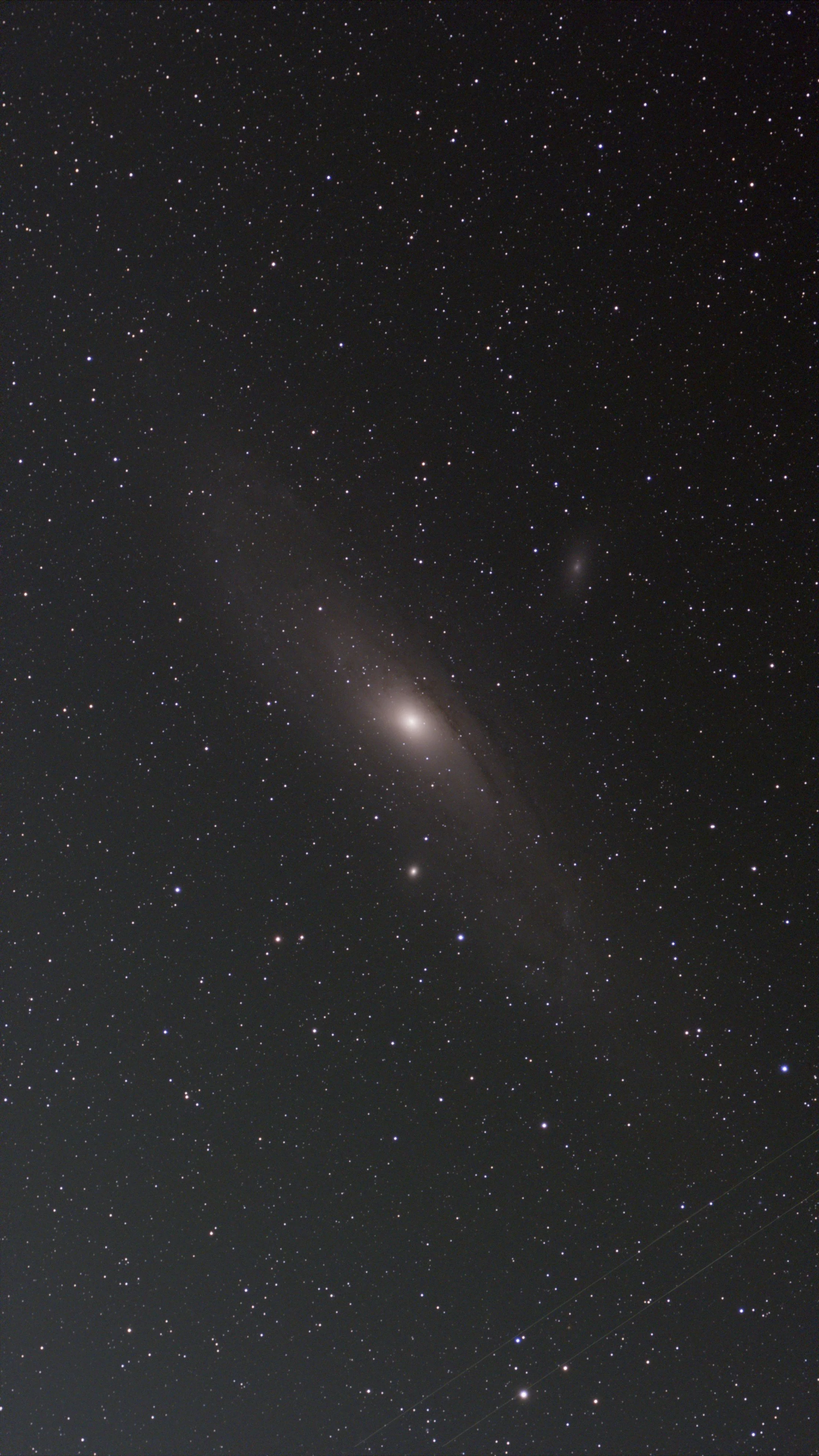
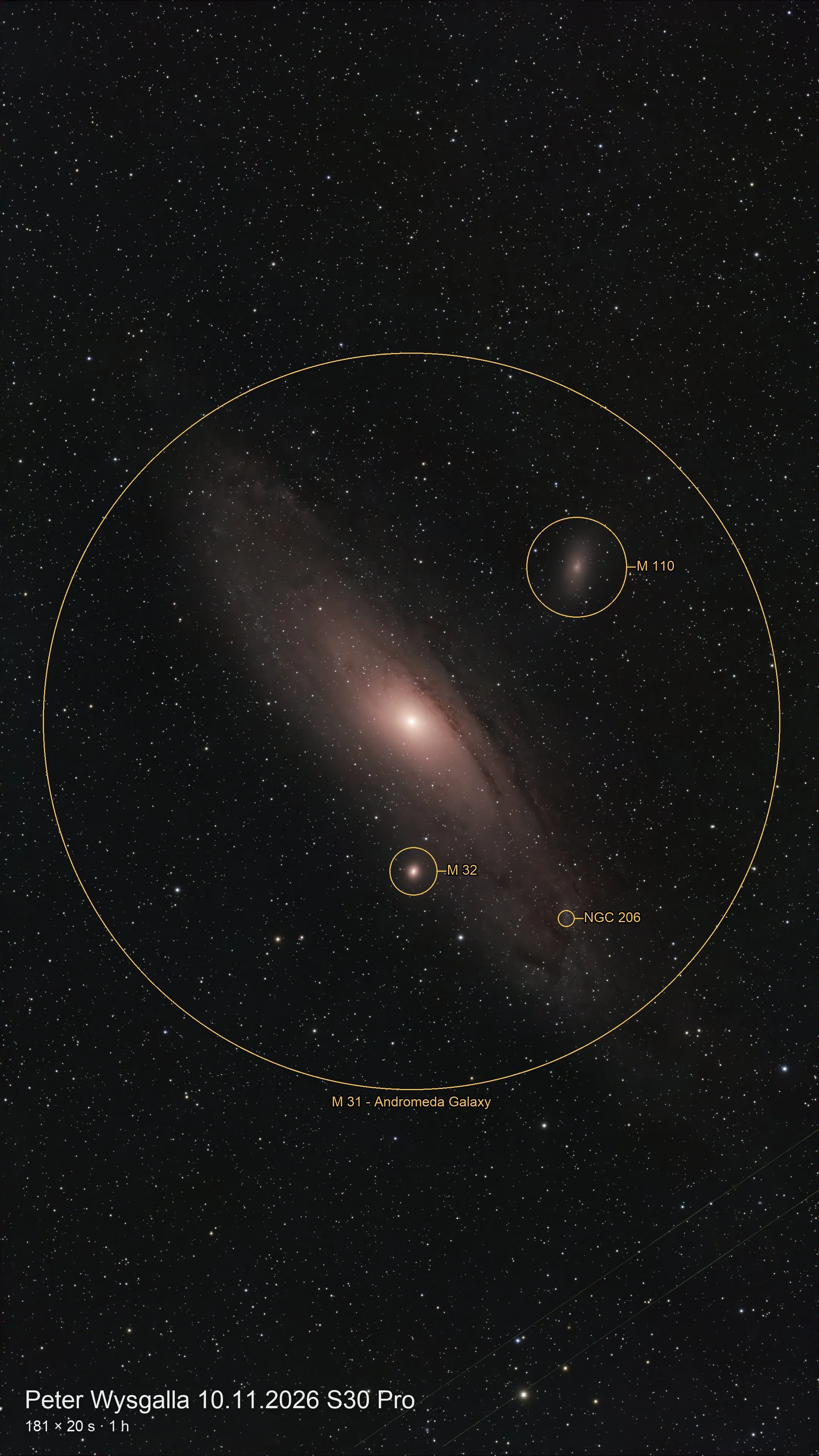
Left: unprocessed S30 Pro stack. Right: AstroWizard, under ten minutes, annotated. Both 181 × 20 s · 1 h.
The dust lanes now run the full length of the near side of the disk. The outer arms stretch much farther toward the edges of the frame. M110 went from a smudge to a small galaxy with real structure, and M32 sits cleanly against the disk. The annotation even picked out NGC 206, the large star cloud in the southwest arm.
Is it a PixInsight masterpiece? No. But it's a “good enough” image I'm proud of, made in less time than it took to set up the scope. For anyone imaging under city skies who has been scared off by processing, that may be what matters most.
What I'm taking away
- A one-hour smart-telescope capture from Bortle 9 holds more than the raw stack shows.
- A guided workflow can get you most of the way there in minutes.
- And if you live near an airport, your sky meter may be keeping track of the flights for you.
AstroWizard: astrowizard.lukomatico.com
Clear skies / Pete // bortle9astro.com