What the Rosette Didn’t Tell Me
Update · October 2026
The read-noise hypothesis below didn't hold up.
Eight months later, I reprocessed the same 120 × 30 s S30 Pro data with AstroWizard and the RC-Astro tools, and the OIII was there all along. The S30 Pro captures it just fine from Bortle 9, and 30-second subs work well. The limitation was my processing at the time, not the telescope, the filter or the sub length.
I've left the original note below unchanged. It's an honest record of how I reasoned through the problem then, including where I went wrong. The full story of what changed is in Rosette Redux.
Here's the same March data, reprocessed:
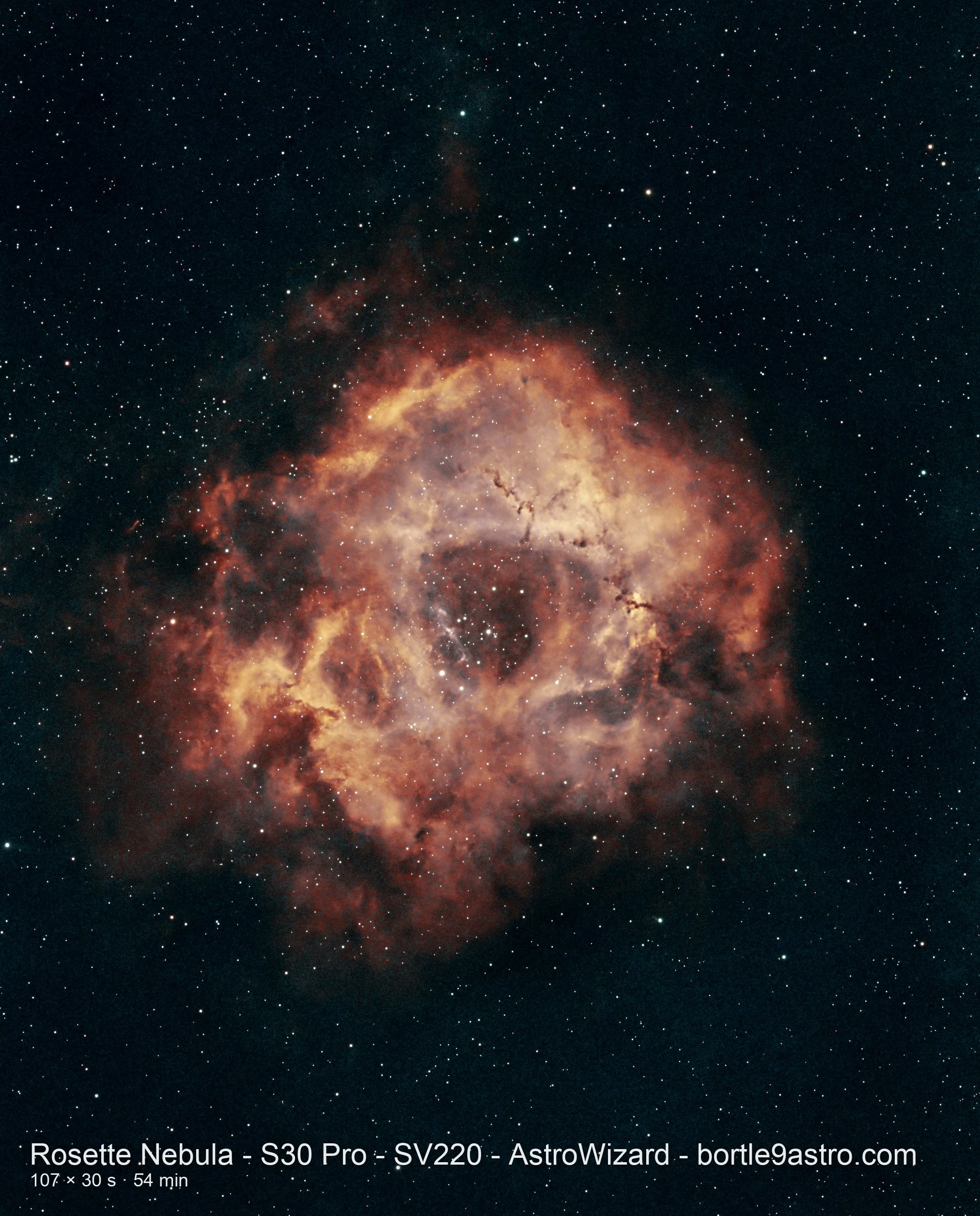
A narrowband mystery, a systematic investigation, and an experiment waiting for clear skies.
I was pretty pleased with myself after the Rosette.
Sixteen minutes of integration. A Bortle 9 park. Two stunning palettes — HOO and SHO — from the same master file. It felt like proof that narrowband imaging from suburban Chicago was not just possible, but genuinely capable of producing beautiful results.
So when I turned the Seestar S30 Pro toward the same target a few weeks later — with the same external 7nm dual-band filter, sixty minutes of integration, and better seeing conditions — I expected more of the same. Maybe even better.
I couldn't build an HOO palette. The OIII channel simply wasn't there.
The Setup Comparison
Here's what the two sessions actually looked like side by side:
| Parameter | FRA300 Session | S30 Pro Session |
|---|---|---|
| Date | Feb 11, 2026 | Mar 23, 2026 |
| Aperture | 50 mm | 30 mm |
| Focal Length | 300 mm (f/5.0) | 160 mm (f/5.3) |
| Sensor | ZWO ASI585MC | ZWO ASI585MC |
| External Filter | SVBONY SV220 7nm | SVBONY SV220 7nm |
| Sub Length | 60 s | 30 s |
| Total Integration | 16 min (16 × 60s) | 60 min (120 × 30s) |
| Seeing | Below average | Average |
| Transparency | Average | Average |
| Result | HOO + SHO ✓ | Ha only |
Same sensor. Same filter. Better conditions and nearly four times the integration time on the S30 Pro. And yet.
Ruling Things Out
My first instinct was aperture. The FRA300 at 50mm collects nearly three times the light of the S30 Pro's 30mm — that's not a small difference. But then I did the math on total light gathered:
The S30 Pro actually collected more total light. Aperture alone doesn't explain it. I kept going down the list — filter, sensor, sky conditions, integration time — and kept hitting dead ends. Which left one remaining suspect.
The Read Noise Problem
The S30 Pro session used 30-second subs. The FRA300 session used 60-second subs.
For Ha on the Rosette — a target that practically glows in hydrogen-alpha even under Bortle 9 — sub length doesn't matter much. The signal is strong enough to swamp read noise in almost any reasonable exposure.
But OIII on the Rosette is genuinely weak emission. And with weak signal, every individual frame has to overcome the camera's read noise just to register usable data.
This is the kind of thing that's easy to miss when you're thinking about integration time as a simple sum. It isn't. Sub length and read noise interact, and that interaction matters most exactly where you can least afford it — on faint emission from a moderately difficult target under heavy light pollution.
The Experiment
The S30 Pro supports subs up to 60 seconds. I haven't tried it yet.
The plan: same target, same external filter, same everything — but 60 × 60s instead of 120 × 30s. If the OIII channel comes alive, read noise accumulation was the culprit all along, and the S30 Pro is more capable at narrowband than the Rosette made it appear.
If it still falls short, the investigation continues.
The Rosette season is nearly over. The moon is close. Clear skies near O'Hare in March are their own kind of challenge.
But the experiment is designed. The hypothesis is clear. Part 2 of this note will publish when the sky cooperates.