Does a Light-Pollution Filter Help on Andromeda? A Same-Night Test from Bortle 9
Field Note: same night, same Seestar, same recipe, two filters on M31
Ask on any forum whether a light-pollution filter helps on galaxies from the city and you’ll get a dozen confident answers pointing in a dozen directions. I own an Optolong L-QEF, I image under a Bortle 9 sky next to O’Hare, and Andromeda is high in the east every evening this fall. So I decided to stop guessing and measure it.
Earlier in October an L-QEF hour under an 81% Moon had looked almost as good as a moonless hour without the filter. That was two different nights, though, and two different nights can hide almost anything. This time I wanted a fair fight.
The test
On October 29 I imaged M31 with my Seestar S30 Pro in four blocks, alternating filters so that M31 climbing higher and the rising Moon would affect both filters equally:
- A1 no filter (the Seestar’s IR-cut), 8:20–8:37 PM
- B1 L-QEF, 8:40–8:57 PM
- B2 L-QEF, 9:00–9:20 PM
- A2 no filter, 9:23–9:42 PM
Same 30-second subs for both. Clear sky, an AIQ of 29–30 at the zenith (17.6–17.7 mag/arcsec²), and an 80% Moon rising in the east about 65° from M31. And, this being Park Ridge, planes. Lots of planes. Twelve subs per filter had an O’Hare arrival streaking through Andromeda and were set aside, leaving 55 subs without the filter and 53 with it. Both stacks went through the identical AstroWizard recipe.
Here are the two results:
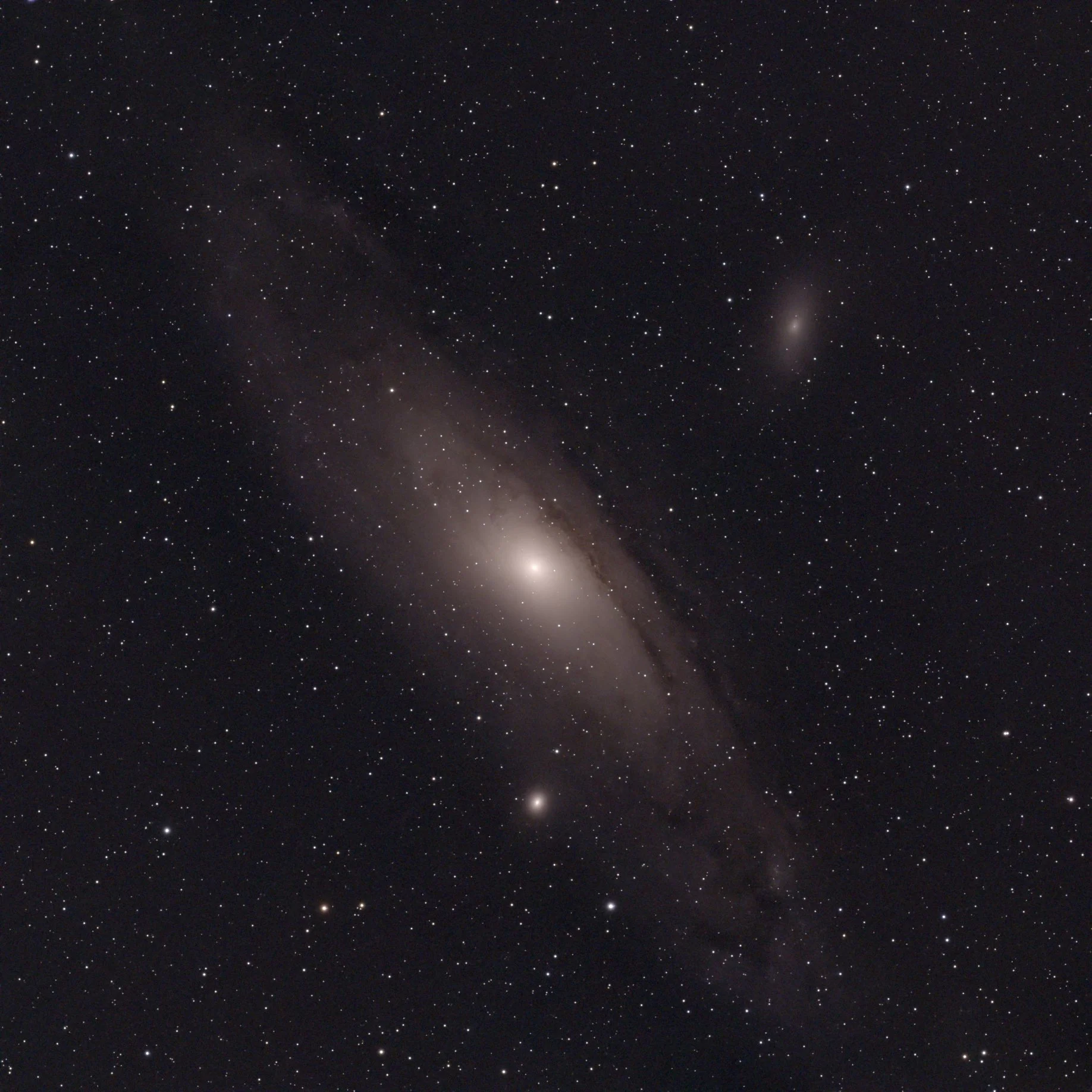
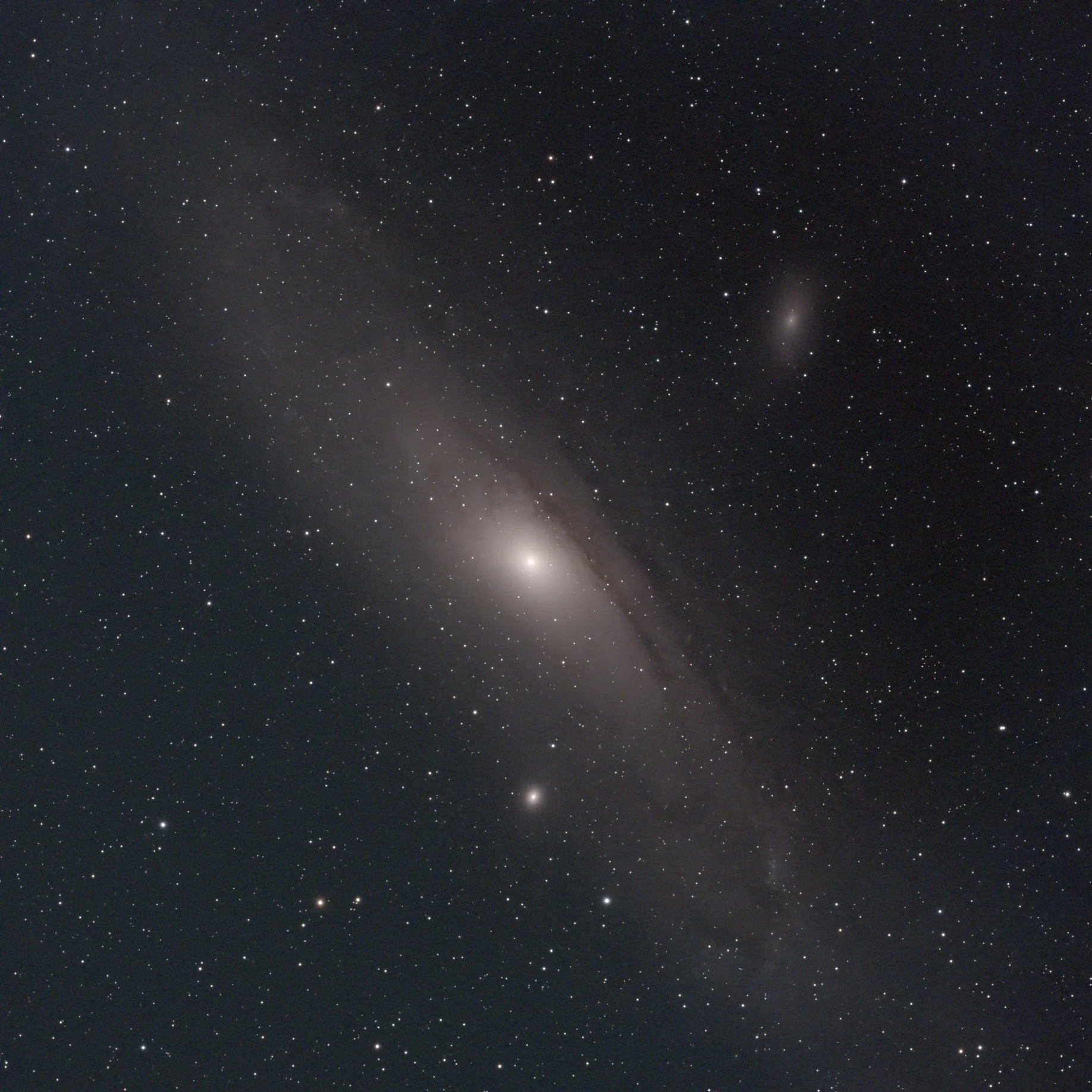
Left: no filter (IR-cut), 54 × 30 s. Right: Optolong L-QEF, 51 × 30 s. Same night, same Seestar S30 Pro, same AstroWizard recipe.
At first glance the L-QEF version seemed to win. Its outer disk reaches farther toward the edges of the frame. I was ready to write that the filter earns its keep. Then I looked at the numbers.
The data says the opposite
Per sub, the unfiltered frames carry 27% more galaxy signal relative to the noise than the L-QEF frames. Not on one lucky block, either: the two IR-cut blocks agree with each other, and so do the two L-QEF blocks.

Why would a light-pollution filter lose under light pollution? Because of what my light pollution looks like. The L-QEF passed about 45% of the galaxy’s light and about 42% of the sky’s. It cut both almost equally, so the galaxy didn’t stand out any better against the sky. It just got fainter. Filters like this were designed for skies lit by sodium and mercury lamps, whose light comes in a few narrow colors you can block. My neighborhood is lit by white LEDs, and white LED light is spread across the spectrum much like starlight. You can’t filter out one without the other.
To make up the 27%, the L-QEF would need roughly 1.7 to 2 times the imaging time.
So why did the filtered image look better?
The answer was in the processing, not the filter. The unfiltered stack had a sky gradient about 3.5 times stronger than the L-QEF stack (the Moon was rising low in the east, on the same side of the sky as Andromeda). Background extraction removes a gradient by modeling the sky across the whole frame. M31 nearly fills the Seestar’s field, so while GraXpert was taking out the strong gradient, it also took out the faint outer disk, mistaking it for sky. The L-QEF’s flatter sky gave GraXpert less to remove, and the outer disk survived.
The test of that idea was simple: I reprocessed the unfiltered stack with gentler GraXpert smoothing (0.9 instead of 0.5). The outer disk roughly doubled in brightness at 30–50 arcminutes from the core. It didn’t fully catch up, but the darker, more natural unfiltered image now shows more dust-lane structure, and it’s the one I’ve kept for the gallery.
What I’m taking away
- For galaxies under a white-LED sky, skip the broadband light-pollution filter. It cost me 27% of the signal per sub. Spend the time on more subs instead.
- Save the narrowband filter for emission nebulae. A 7 nm dual-band filter is a different story on the Heart or the Soul, because those nebulae glow at the exact colors it lets through.
- Be gentle with background extraction on big targets. When a galaxy fills the frame, the tool that removes your gradient can remove your galaxy too. Smoothing 0.9 in GraXpert worked better for M31 than 0.5.
- The filter does flatten the sky. That’s a real convenience for processing. It just isn’t free.
I’ll admit I was rooting for the filter. It’s a nice filter, and I paid for it. But a same-night test doesn’t care what I was rooting for, which is exactly why it’s worth doing.
Pete // bortle9astro.com