Aperture Isn't the Whole Answer
HOO Palette · S30 Pro vs. FRA300 · Bortle 9 · April 2026
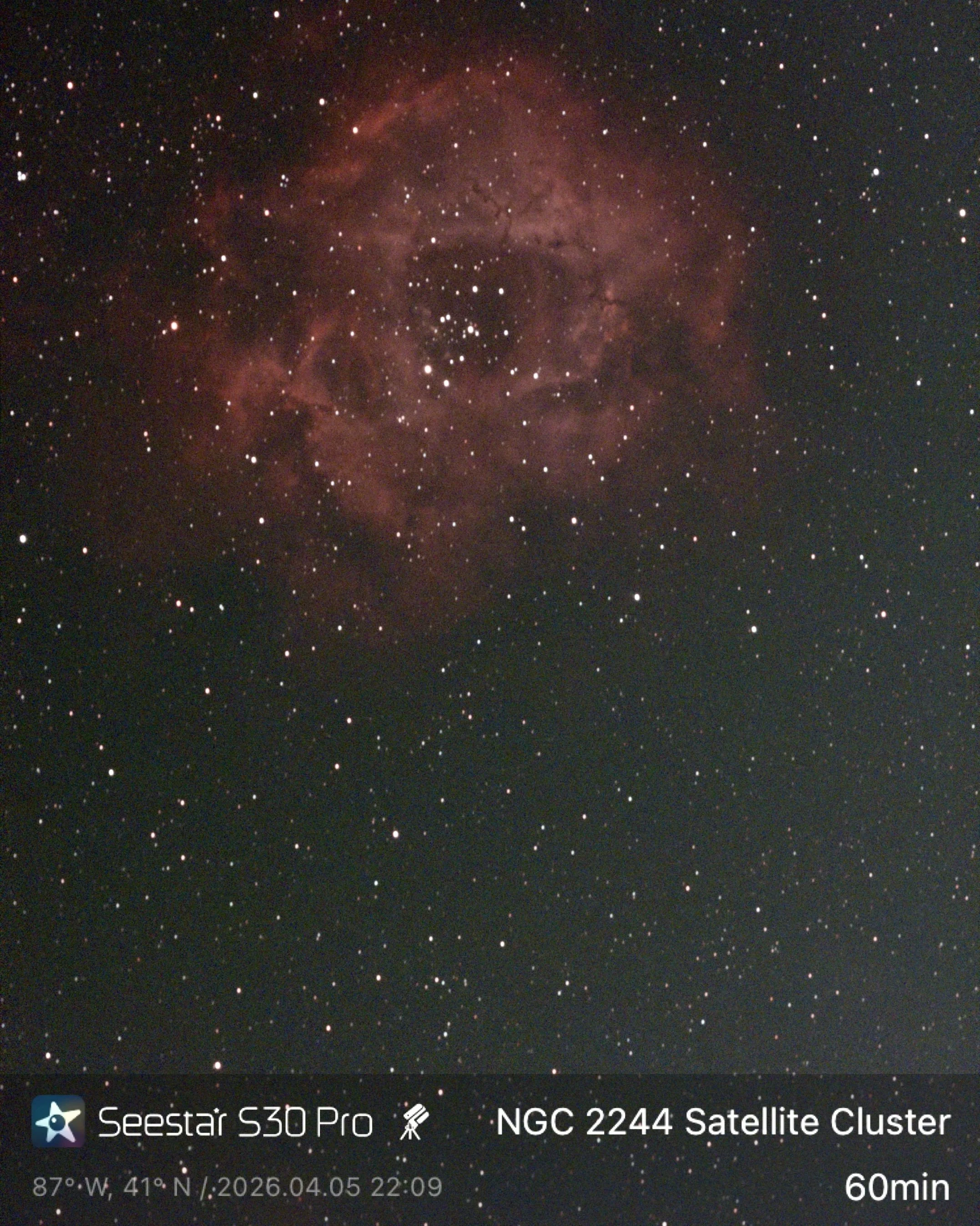
The experiment wasn't supposed to happen over Easter weekend. Two hours of clear sky appeared without warning — a gift the Chicago suburbs rarely offer in April — and the Seestar S30 Pro was already set up. One hour on the Rosette Nebula. Same target, same filter, same sky as the FRA300 session from February. The comparison that had been waiting since winter was suddenly possible.
The result was not what I hoped for. It was more interesting than that.
The S30 Pro HOO result from this session is above. For comparison, the FRA300 HOO image — 16 minutes, same filter, same sky — is in the Nebulae gallery.
What I Expected vs. What I Got
The hypothesis going into this session was about sub-length: that the S30 Pro's weak OIII performance in the original Rosette data was partly a function of how it accumulates signal across its internally stacked frames. More total integration time, the thinking went, might give OIII somewhere to breathe.
An hour of data — four times the February session — should have tested that. Instead, the OIII channel came out as noise. Not faint signal buried in noise. Just noise. Both the SHO and HOO palettes collapsed to essentially monochrome hydrogen images with color that couldn't survive the stretch.
The HOO result
Strong, well-structured Hα. Beautiful filament detail across the full ring. OIII rendered as teal speckle across the background — amplified noise, not oxygen emission. The palette was working correctly. The signal wasn't there to fill it.
The FRA300 HOO image from February tells a different story. Sixteen minutes of integration. Rich hydrogen structure in red-orange, genuine teal in the outer nebula where OIII emission is strongest, dark rifts cleanly separated, a black background. Real palette rendering from a quarter of the integration time.
The Numbers Behind the Gap
The two rigs share almost everything: same filter, same sky, same target, same processing pipeline. What they don't share is aperture.
| Parameter | Seestar S30 Pro | FRA300 |
|---|---|---|
| Aperture | 30mm | 60mm (FRA300/5.0 APO) |
| Light-gathering area | ~707 mm² | ~2,827 mm² |
| Relative collecting power | 1× | ~4× |
| Integration (this experiment) | 60 minutes | 16 minutes |
| OIII result | Noise | Visible structure |
Aperture area scales with the square of the diameter. A 2× increase in aperture means 4× the light-gathering power — and the S30 Pro's internal stacking pipeline appears to compound that disadvantage for faint OIII signal.
OIII at 500nm is a genuinely faint signal compared to Hα at 656nm, even in a bright emission nebula like the Rosette. The FRA300's aperture advantage means each frame arrives with roughly 4 times more photons. That alone doesn't fully explain the gap between "beautiful teal structure" and "pure noise" — which suggests the S30 Pro's internal stacking pipeline is also working against OIII signal in ways that compound the aperture disadvantage. Four times the integration time compensates for a factor of four in signal, in theory. In practice, the result suggests the deficit runs deeper than aperture alone.
What This Changes About the Experiment
The original sub-length hypothesis — that the S30 Pro's OIII weakness is partly a function of how read noise accumulates across short internally-stacked frames — may still be true. But it appears secondary to a more fundamental constraint: the S30 Pro is aperture-limited for OIII at Bortle 9, regardless of how long you integrate.
This reframes what the Eastern Veil experiment in June is actually measuring. The Cygnus Loop is a supernova remnant with exceptionally strong OIII emission — among the brightest OIII targets in the sky. If any target can push usable oxygen signal through a 30mm aperture, it's the Veil. That session will answer a cleaner question: not whether the S30 Pro can compete with the FRA300 on OIII, but whether it can produce any usable OIII signal at all under the best possible conditions for that signal.
What the Seestar does well
None of this diminishes what the S30 Pro actually is: a remarkable all-in-one imaging system that produces excellent Hα results with zero setup friction. For targets where Hα dominates — the Orion Nebula, the Lagoon, the Eagle — it punches well above its aperture class. OIII-rich targets in HOO or SHO palette are simply outside what 30mm can deliver at this sky.
Where This Leaves the Story
The Rosette data from Easter weekend isn't the image I was hoping for. But it produced something more durable: a clean, reproducible result that clarifies exactly where the S30 Pro's ceiling is and why. The FRA300 HOO image from February — 16 minutes, full palette rendering, genuine teal — is now the baseline the Eastern Veil experiment will either confirm or complicate.
The sky gives you crumbs. Sometimes the crumbs spell out an answer.
Clear skies / Pete // bortle9astro.com
Related: What the Rosette Didn't Tell Me · Field Guide #1 — HOO Palette Workflow